Little Service Guide
28th May 2020
Everything you wanted to know about Fenix flashlights (*but were afraid to ask)
Notice to readers: The following lines might seem like a list of complete banalities and obvious points that shouldn't even need mentioning regarding such a common tool as a flashlight. However, we honestly declare that these recommendations are based on real warranty claims and interventions by our service department.
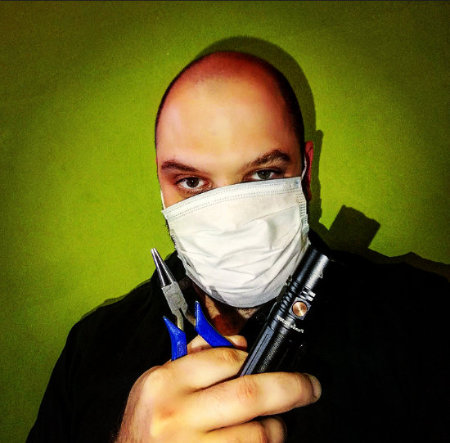
This is Martin, our service technician
Imagine you've just brought home a beautiful orange-and-black box with a Fenix flashlight, and now, full of joyful anticipation, you're taking it out. All that's left is to press the control button and… nothing happens.
Another time, you might have performed a series of random button presses on your seasonally used headlamp because you don't remember exactly how to operate it after a long summer. The result is that it just blinks at you twice and nothing else happens.
Or perhaps you left your Fenix on a shelf, in a backpack, or in a workshop for a while, and since you didn't need it, you simply didn't pay it any attention. Now, when you suddenly need it, you pick it up, try to turn it on, and it doesn't even flicker.
What now? You don't have to pack the flashlight right away and send it to our service department. It might be enough to just carefully re-read the manual or try a few proven tricks from our little service guide.
Dear readers,
Fenix headlamps and flashlights often have a built-in lock to prevent them from turning on accidentally in bags and backpacks. You usually activate and deactivate it by holding the button or double-clicking. You can tell the light is locked if it only blinks twice when you press the button. It isn't broken, just locked. For lights where the locking option isn't specifically mentioned in the manual, you can rely on the "old scout trick" – loosening the tailcap of the flashlight or headlamp by a quarter turn.
Yours, Martin
Joy of the First Purchase
We have a few tips for those who have just acquired their first Fenix flashlight or are seriously considering buying one.
- If you are getting a new flashlight, make sure the package includes a battery or accumulator. A clear indicator is the presence of a charging connector on the body of the light. The manufacturer sells all rechargeable flashlights including the accumulator. However, there are exceptions where the manufacturer includes an accumulator equipped with a micro-USB port, or models that run on AA or AAA batteries, which are included in the package even if they are not rechargeable models.
- Did you get a flashlight that already has an accumulator in the package, but it still won't light up? Remove the insulating tab. When you unscrew the tailcap, you will find a plastic insulating disc on one side of the accumulator that needs to be removed. The manufacturer inserts it so the light won't turn on during transport, but right now it's preventing contact.
- Still not lighting up? Check the tailcap tightness. You might have just checked the battery and then carefully tightened the cap to avoid damaging the new light. That's a mistake. The tailcap needs to be tightened properly, sometimes "firmly" or "all the way." Only then will proper contact be made, and the light will function reliably.
- What to do if the flashlight works but suddenly won't switch to higher output modes? There are two main reasons. Option A: During intense use, the body of the flashlight has overheated, and thermal protection has kicked in. In this case, just wait until the temperature returns to normal while running in a lower mode. Option B: Intense use has partially depleted the battery capacity, and the protective electronics have lowered the output to alert you. If you continued to use the highest mode, you might suddenly find yourself in the dark. Recharging the battery to full will help.
- In the package, you will find several accessories (e.g., a wrist lanyard) or spare parts. For example, a sealing O-ring, which is usually located under the screw-on tailcap. Do not add these to the flashlight as extras. If you insert a second O-ring into the flashlight, contact will be broken and the light will not work.
- Flashlight works, but you don't know how to operate it? Read the included manual, check the product page at Kronium.cz, or watch a video on our YouTube channel where operation is discussed.
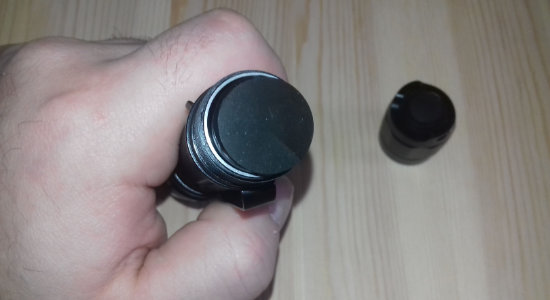
Remove the insulating disc
Dear readers,
please note that no charger will function as a power bank with AA or AAA batteries.
Yours, Martin
The Good Old Flashlight
Haven't used your flashlight for a while? Maybe it spent the summer in a tool bag or forgotten at the bottom of a backpack. Now might be the right time to give it some attention and prepare it for the upcoming dark season.
What can you do for it?
- Does the tailcap open with difficulty? Or can you hear squeaking? Disassemble the light and use a brush (an old toothbrush is best) to clean all threads from dust and dirt.
- Take pure alcohol or a product like Deoxit and clean the contacts inside the light, the threads, and the edges of the flashlight body. Just be careful not to get cleaner on the O-ring, as chemicals can dry it out and damage it.
- Remember how the individual parts were originally assembled. If you use the wrong order when reassembling, the light will not make contact and won't turn on.
- For flashlights with IP68 waterproofing (up to 2 meters underwater), it's necessary to restore the elasticity of the O-ring from time to time. Lubricate it with a suitable lubricant such as Nyogel.
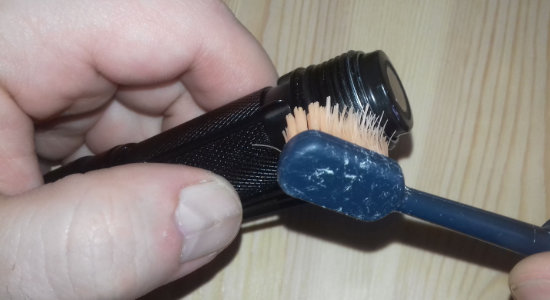
An old toothbrush is sufficient for cleaning
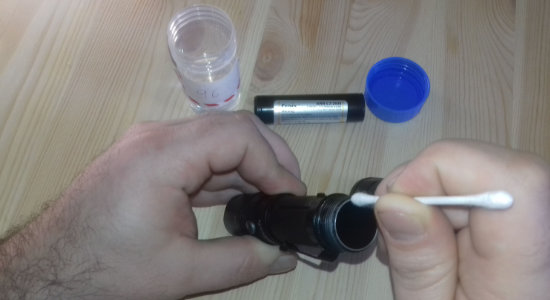
Clean the contacts
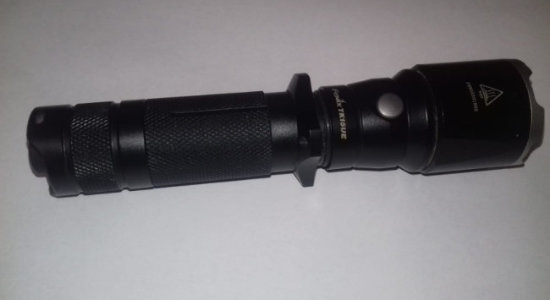
From the service department archives. Can you guess why it won't light up?
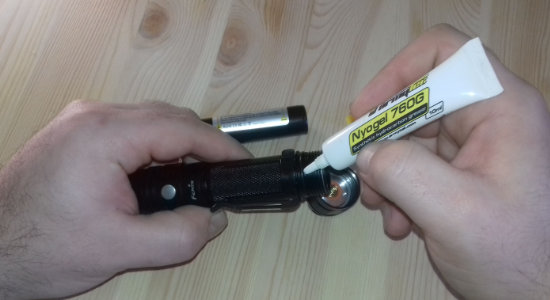
If you want to maintain the waterproofness of the light, it pays to lubricate the O-rings.
It can happen, however, that the flashlight after a break suddenly won't turn on. Or on the other hand, it worked perfectly yesterday and today it won't even blink. What now?
Focus on checking these parameters:
- Check if the accumulator is charged.
- If it is, measure its voltage. A standard Li-ion accumulator should have a voltage between 4.15–4.22V. If you measure below 3V, it won't be able to handle high modes even if "full." If the voltage is below 2.5V, the protective electronics will shut the battery off to prevent deep discharge, and you will measure 0V.
- Don't have a voltmeter? Insert a different accumulator that you know works, or conversely, try the suspect accumulator in a light you know is functional.
- Check the tightness of all components. For example, with tactical lights, a problem can occur if the tactical ring (used for "cigar grip") is even slightly loose. Even if the tailcap is tightened against the ring, the internal contact might not be reaching.
- A common cause is a loose aluminum retaining ring in the tailcap. You can easily check this by inserting pliers or scissors into the two notches in the plate and checking for play. If it's loose, tighten it.
- Simple cleaning of dirty contacts often helps here too. Use a cotton swab dipped in alcohol to clean contacts in the tailcap and at the head of the light.
- Do you need to send the whole light to service immediately? If you've ruled out a battery fault, it's worth finding out if the fault is in the head or the tailcap. Unscrew the cap and temporarily bridge the negative pole of the battery and the edge of the body (where the surface is not anodized) using pliers. If the light turns on, the fault is most likely in the tailcap.
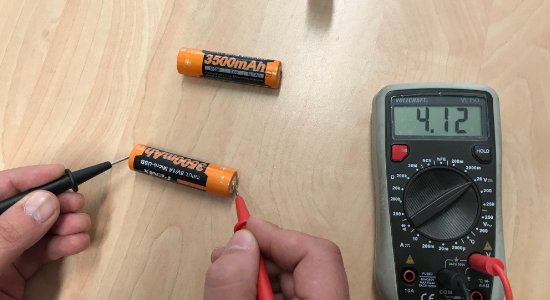
Measuring accumulator voltage using a voltmeter
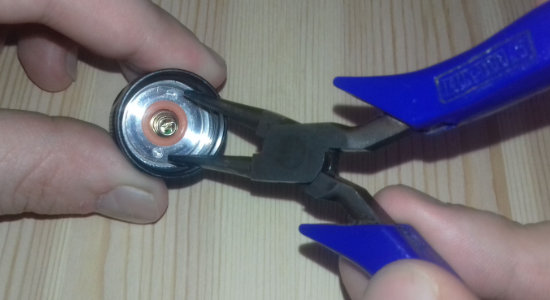
A loose retaining ring is a frequent cause of flashlight failure.
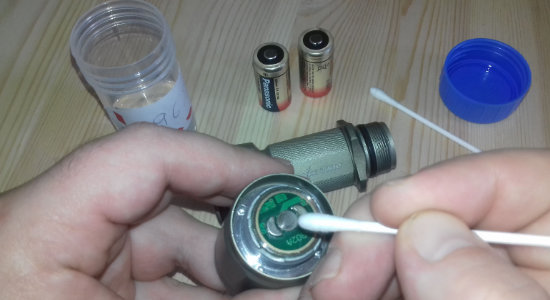
Clean the contacts in the tailcap as well as the head of the flashlight
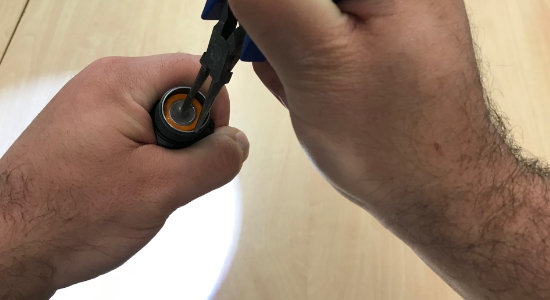
Bridge the accumulator and the flashlight body
What is good to know about accumulators
If the diode is the heart of the flashlight, accumulators are its lungs. Currently, Fenix uses LEDs from two renowned American manufacturers: Luminus and Cree. These are high-quality, efficient diodes guaranteed for 50,000 hours of light. Their failure rate is minimal.
You will have similar peace of mind if you use high-quality original accumulators. Currently, Fenix has almost 100% switched to accumulators based on Li-ion technology; new models using AA or AAA batteries are now only produced in limited quantities.
Dear readers,
do not leave AA or AAA batteries in your flashlights and headlamps when they are not in use. If given the chance to leak, they will. They simply can't help themselves. In contrast, the contents of Li-ion accumulators will not leak; you can leave these in your lights long-term, though we recommend occasionally checking their voltage to prevent total discharge during long storage.
Yours, Martin
What is worth knowing about accumulators? We've written down everything essential in the article About Li-ions without the fairy tales, but still…
- Fenix uses cells from high-quality manufacturers as a base and adds protective and charging electronics. Protective electronics guard against short circuits, overcharging, and deep discharge, which would cause permanent damage to this type of battery. If you want to equip your light with a different battery that looks tempting in price and capacity, make sure it has this electronics. Otherwise, it might be money wasted. Most Fenix lights do not support unprotected batteries without a raised positive pole.
- They come from the factory charged to about 30%, which is the ideal level for long-term storage. When you bring home a new light, it will work, but it probably won't reach the highest mode. Charge your accumulator to full.
- On the other hand, if you know you won't be using the light for a long time, it pays to reduce the battery charge to this level. Then charge it to full just before you head out into action again.
- Li-ion technology does not suffer from the memory effect, so there's no need to "format" the battery by fully discharging it to zero. This is no longer done with this type of cell.
- Li-ion batteries do not suffer from significant self-discharge.
- For good contact, a raised positive pole is required.
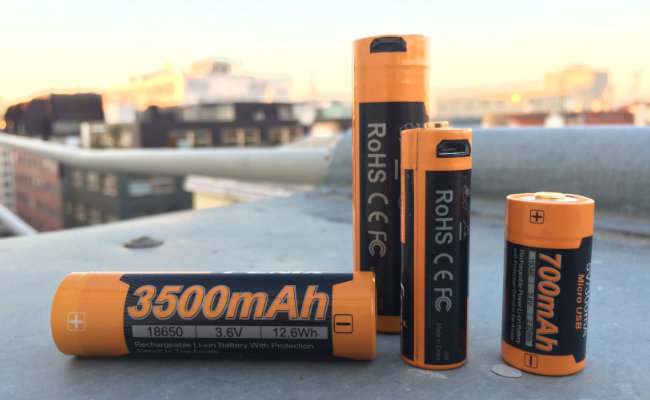
Original Fenix accumulators
Fenix flashlights are known to be durable and practically indestructible. If you like a new model from this brand, you often have to look for reasons to justify buying it. One reason can be the higher performance of modern diodes or higher-capacity batteries. But why buy a new light when the battery can be replaced? It might not be that simple.
- If you have an older Fenix model and want to get a newer and more powerful accumulator for it, measure everything carefully first. Newer batteries can be a few millimeters larger in length or width and might not fit your old light. The best option is to bring the light directly to our store and try it on the spot.
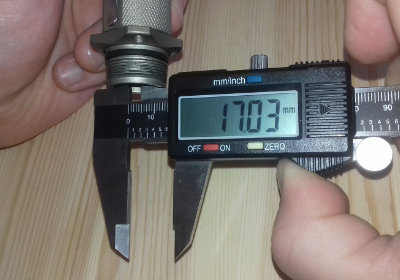
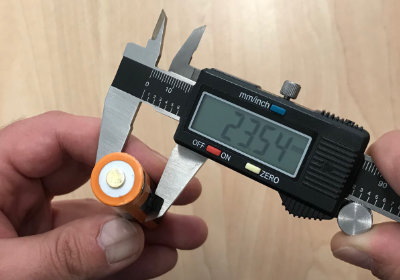
Dimensions of an older flashlight and a new type of Li-ion accumulator may differ
Contact us via email
Still not lighting up? Contact us via email. We are happy to advise you remotely. If remote advice doesn't help, it's time to send the flashlight to our service department for inspection.


